Human History and Skin color
A person’s skin color is primarily determined by the amount and type of melanin, a pigment produced by specialized cells called melanocytes in the skin .When ultraviolet (UV) sunlight hits our skin, people react differently based on their skin color, which is shaped by biology and evolution. The key factor is melanin, the pigment produced by skin cells called melanocytes. There are two forms of melanin: eumelanin (causing brown to black tones) and pheomelanin (causing reddish tones).
Evolution
We humans poped in the sunny savanas of africa where sunlight saturated the grounds, the sunlight mainly composed of Electromagnetic readiation and and other componets
Sun light
1. Electromagnetic Radiation (Primary Components) Sunlight spans a broad range of wavelengths, categorized as:
- A. Visible Light (38–49% of sunlight reaching Earth)
- B. Infrared (IR) Radiation (~52–55%)
- C. Ultraviolet (UV) Radiation (~7–10%)
2. Other Components (Minor but Significant)
- Radio Waves & Microwaves
- X-rays & Gamma Rays
- Solar Particles (Solar Wind)
3. What Happens When Sunlight Reaches Earth?
- Atmospheric Filtering: Ozone layer absorbs most UVC & some UVB Water vapor & CO₂ absorb some infrared.cattering (Rayleigh scattering) makes the sky appear blue.
- What Reaches the Surface ~50% visible light , ~45% infrared (heat) , ~5% UV (mostly UVA, little UVB)
UV radiation triggers melanin production (tanning/darkening).
Migration of humans
The first humans, who evolved in Africa, had dark skin as a vital adaptation to protect against UV radiation. About 250,000 years ago, Homo sapiens emerged, with major migrations starting roughly 100,000 years later. Movement out of Africa happened in waves, with significant migrations beginning around 70,000 years ago. In Africa, darker skin with high eumelanin levels evolved as a protection against UV damage and skin cancer (melanoma). Melanin acted like a natural sunscreen, shielding cells from UV harm.
During this time, a mutation in the KITLG gene appeared in populations moving into the Middle East, influencing melanin production and leading to lighter skin shades. This mutation spread with humans migrating into Europe, Asia, and the Americas, but it did not appear in groups that stayed in Sub-Saharan Africa or migrated south into Australia or Indian peninsula.
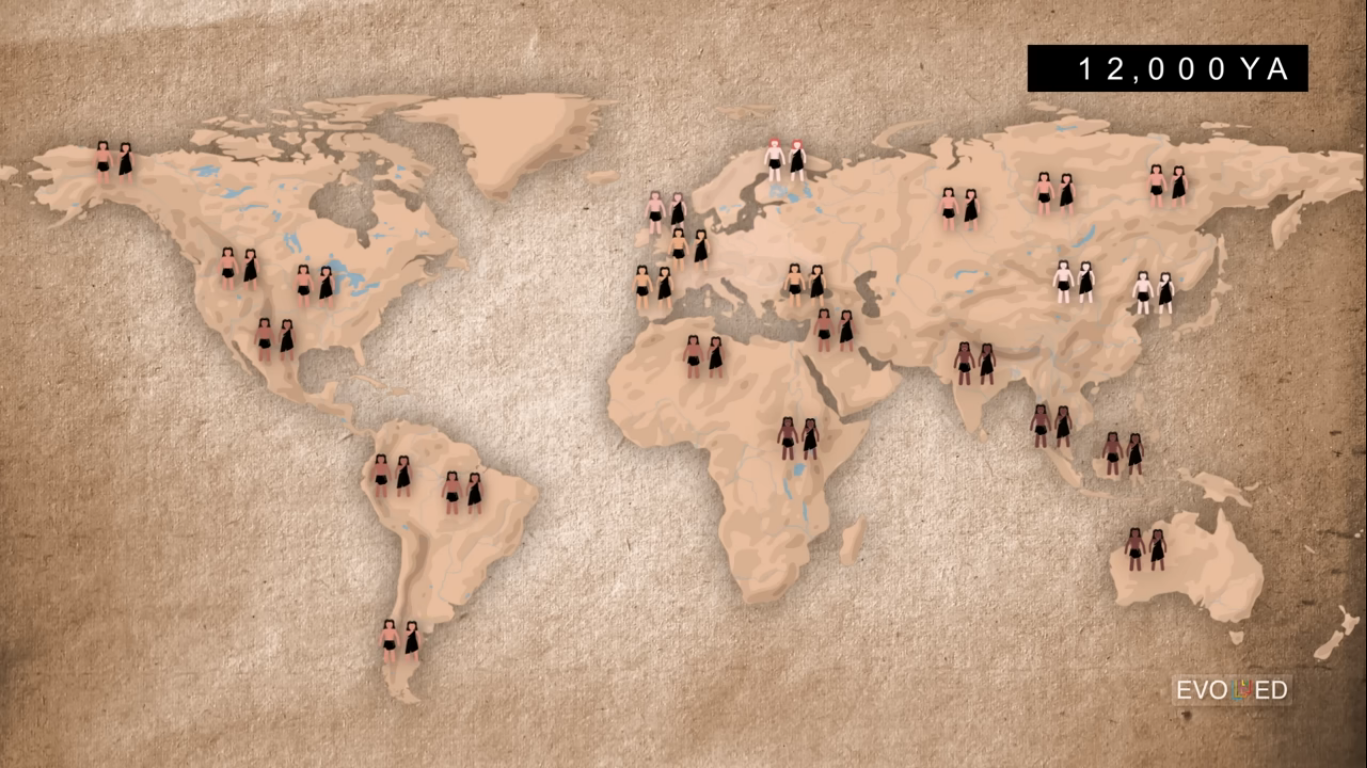
Later, as humans moved farther north into areas with less sunlight, darker skin became a disadvantage because it blocked too much UV, hindering vitamin D production with the population spread to northern Europe and northeastern Asia, further mutations occurred (in SLC24A5, SLC45A2, MFSD12, OCA2, and MC1R genes), promoting lighter skin to better adapt to regions with less sunlight. Individuals with lighter skin, producing less melanin, absorbed more UV and produced more vitamin D, giving them a survival advantage in northern climates. .By 10,000 years ago, humans had populated nearly every part of the Earth. Skin color evolved mostly due to natural selection based on latitude and sunlight exposure, with darker skin near the equator and lighter skin closer to the poles.